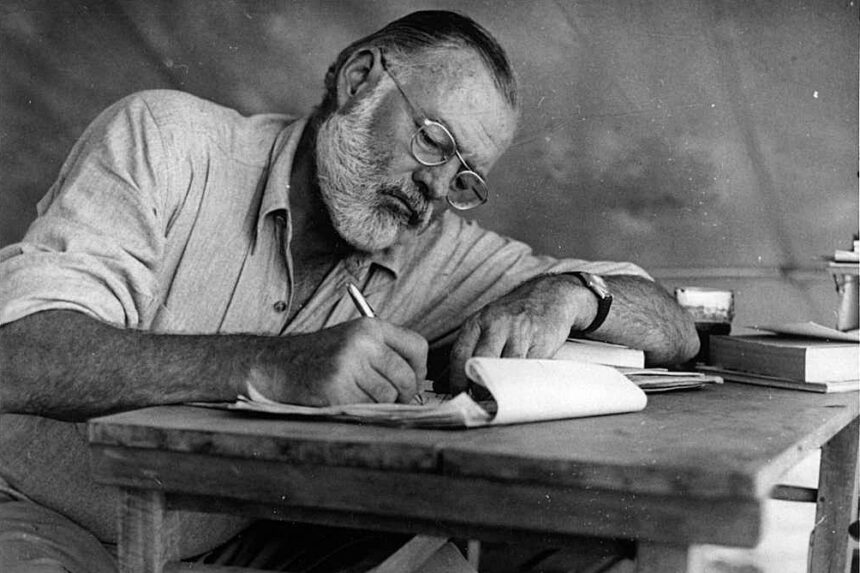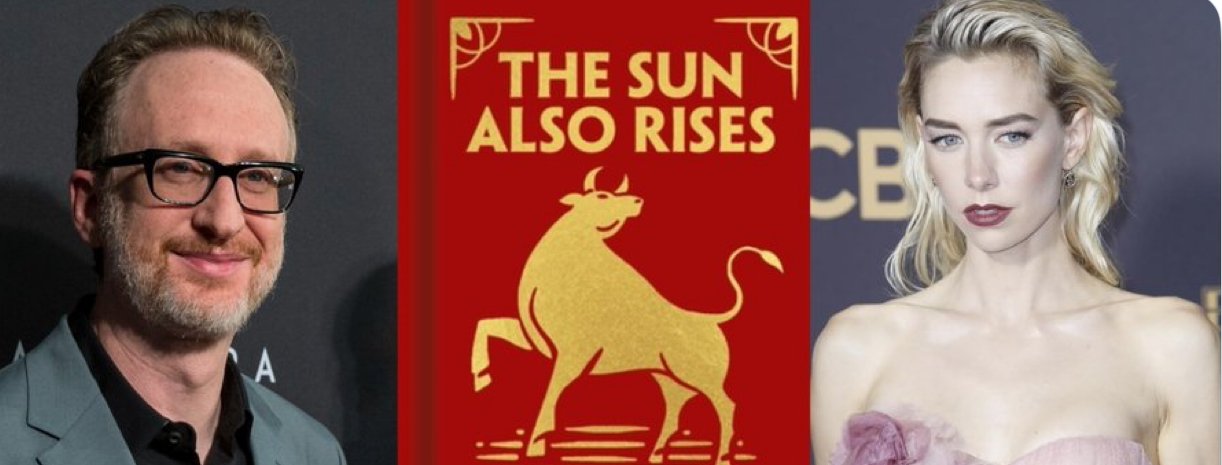
This is SO FUN and INTERESTING! Now I understand why Dorothy Parker is so acclaimed. This was sent to me by a dear friend, Don, who is also another Hemingway scholar and reader! ENJOY.

The New Yorker


People Want to Hear Things about Ernest Hemingway
Once there was a traveller who journeyed alone to the Grand Canyon. He came to the brink just as the day died, and the slow mists circled upward. There he stood and he looked.
And there came, from behind him, the sound of footsteps—large, firm steps dealt by the accustomed feet of a lady tourist. She gained his side and stopped there, radiating native friendliness and the good cheer provided by Fred Harvey. She, too, looked. And woman’s world-old need of speech seized her, and seemed as if it would rack her very tweeds apart.
“Well!” she said. “It certainly is attractive.”
And I feel, my friends—for I think of every one of you gathered here tonight as my friend, and I want you to think of me that way, too!—I feel not unlike that good lady of the Canyon when I am asked by this hospitable house-organ to speak a few words about Ernest Hemingway. Well! He certainly is attractive.
For it is so neat in my mind that the author of “In Our Time,” “Men Without Women,” and “A Farewell to Arms” is far and away the first American artist, that it is the devil’s own task to find anything more complicated or necessary to say about him.
It is no misses’ size assignment to dash off a description of Ernest Hemingway, Writer and Human Being. One hesitates, in the first place, to add to the measure of bilge that has already been written; probably of no other living man has so much tripe been penned and spoken. And it is the present vogue to rip off sketches of the famous in a sort of delicate blend of the Anecdotal, or Brightest-Things-Our-Baby-Ever-Said, manner, and the Tender, or Lavender-and-Old-Rubbers, school. As a subject, Mr. Hemingway does not lend himself to the style. He will not—indeed, it is my belief that he can not—pluck you down from his memory any cobwebby pretties about his favorite school-teacher; nor will he help you along with your work by uttering Good Ones that you can set promptly on clean white paper. There are anecdotes about him, and beauties, too; and there are quotations from his conversations that, I think, must pass eventually into folk lore. But I may not give them to you here. I am sorry but I really can not feel that we are well enough acquainted for that. Mrs. Parker to you, if you please.
But people want to hear things about Ernest Hemingway. As the boys used to say, before they left the phrase flat and ran off in all directions with “gesture,” “good theatre,” and “the American scene,” he intrigues the imagination. People so much wanted him to be a figure out of a saga that they went to the length of providing the saga themselves. And a little peach it is.
I have heard of him, both at various times and all in one great bunch, that he is so hard-boiled he makes a daily practice of busting his widowed mother in the nose; that he dictates his stories because he can’t write, and has them read to him because he can’t read; that he is expatriate to such a degree that he tears down any American flag he sees flying in France; that no woman within half-a-mile of him is a safe woman; that he not only commands enormous prices for his short stories, but insists, additionally, on taking the right eye out of the editor’s face; that he has been a tramp, a safe-cracker, and a stockyard attendant; that he is the Pet of the Left Bank, and may be found at any hour of the day or night sitting at a little table at the Select, rubbing absinthe into his gums; that he really hates all forms of sport, and only skis, hunts, fishes, and fights bulls in order to be cute; that a wound he sustained in the Great War was of a whimsical, inconvenient, and inevitably laughable description; and that he also writes under the name of Morley Callaghan. About all that remains to be said is that he is the Lost Dauphin, that he was shot as a German spy, and that he is actually a woman, masquerading in man’s clothes. And those rumors are doubtless being started, even as we sit here.
For it is hard not to tell spectacular things of Ernest Hemingway; people are so eager to hear that you haven’t the heart to send them away empty. Young women, in especial, are all of a quiver for information. (Sometimes I think that the wide publication of that smiling photograph, the one with the slanted cap and the shirt flung open above the dark sweater, was perhaps a mistake.)
“Ooh,” they say, “do you know Ernest Hemingway? Ooh, I’d just love to meet him! Ooh, tell me what he’s like!
Well, I warned you the task sinks me. Ernest Hemingway is something—not exactly—like this:
He has, I should think, the best and the worst times of anybody living; he experiences several examples of both, every day. He has an uncounted number of interests, and a passionate concentration. Whatever he does, he goes in for hook, line, and good red herring. He has a generosity of energy that is absolute. He has a capacity for enjoyment so vast that he gives away great chunks to those about him, and never even misses them. I can say no more of him than that he can take you to a bicycle-race, and make it raise your hair.
He is in his early thirties, he weighs about two hundred pounds, and he is even better than those photographs. The effect upon women is such that they want to go right out and get him and bring him home, stuffed. Heaven help him, if he ever settles in New York and is displayed to the sabre-toothed ladies of stage, pen, salon, and suburb who throng the local Bohemian gatherings. He is susceptible to flattery, and then is stuck with the flatterer. He is afflicted with deep-seated illness in the presence of unhappily married women who are interested in the Arts.
His father was a Middle-Western doctor. I can find out nothing about his education—probably he read a lot of things. Anyway, he left home at something below the conventional early age, with the englamoured idea of being a prizefighter. (He was a bad prizefighter, so he is now a good amateur boxer.) Then he became a reporter, somehow, and then he went abroad, and Then Came the War, and there he was, in the Italian army. He suffered seven major wounds, and has a life-sentence to wear an aluminum kneecap. He received medals; it makes him sick if you ask him about them. He does not talk about the War, especially if you lead up to it.
He lives, for a bit of every year, in Paris—which is how the expatriation stories started. He and his wife do this because they like it, and because their rent is not high. (He doesn’t make much money—not half as much as you do.) They form no part of the dancing-and-light-drugs life of the French capital. Their apartment has no telephone; and any engagement made by telegram, letter, or word-of-mouth for a time set several days ahead throws Mr. Hemingway into one of those states of his—he hates anything, bad or fair, hanging over him. He writes there, mostly in bed, and he reads books that have a great many things going on in them—novels by the elder Dumas, and books and books and books about the Crusades.
When the Hemingways come to the United States, they dwell in the outlands. Their baby was born in Arkansas, and they spent last Winter in Key West, deep-sea fishing, and killing with harpoon or gun the major items of their menus. He avoids New York, for he has the most valuable asset an artist can possess—the fear of what he knows is bad for him. Somehow, you can not fit him into the jig-saw puzzle of New York life. Drink he does and did and will again, but he was not designed for night-clubs, and it is virtually an impossibility for him to speak easy. The mind refuses to function over the idea of his presence at a literary tea, or an evening of parlor games. Nor is his ambition beckoned toward the North Shore of Long Island. “Scratch a writer,” once I heard him say, “and find a social climber.” But nobody, including himself, can be with him, and keep remembering that he is a Writer.
With the possible exception of Ring Lardner, he is less the literary character-part than any author I have ever seen. Nothing is done about the thrill of creating, nor the need for expression, nor even the jolly good fun of spinning a yarn. He works like hell, and through it. Nothing comes easily to him; he struggles, sets down a word, scratches it out, and begins all over. He regards his art as hard and dirty work, with no hope of better conditions. He listens, with something of the expression of the tattered orphan outside the bakeshop window, to the literati’s tales of the necessity of still and pleasant surroundings and the employment of expensive devices to ease the gestating mind. Once he heard the odyssey of a highly-valued American writer; an account of ceaseless, fruitless flights to the more luxe, yet recondite, nooks of the globe, in quest of what was called “a good place to work.”
“—————,” Ernest Hemingway said, mentioning a certain word by name, “the only good place to work is in your head.”
Seventy times he rewrote the concluding pages of “A Farewell to Arms.” He had no idea of ever being completely satisfied with them; he merely hoped that the words would eventually come nearer to his meaning. The pile of scribbled-out sheets made a formidable manuscript. Seventy times . . . “Now I suppose,” he remarked, “they’ll say that the ending is hurried.”
He is outrageously sensitive to criticism—probably because his work has begot some specimens that should really be preserved in alcohol. The American Mercury dismissed “In Our Time” as “sketches in the bold, bad manner of the Café du Dôme.” A certain young gentleman dedicated to beautiful letters confessed with a sort of laughing pride—in the pages of an organ also dedicated to beautiful letters—that he just wasn’t able to “understand some of the stories in ‘Men Without Women.’ ” There was another young gentleman who once occupied the editorial chair of a now defunct magazine of culture, and sought, from there, to form the taste of the American public; he was shown some of Hemingway’s work, then unpublished in the United States, refused it, and pronounced, “I hear he has been a reporter—tell him to go on reporting and not try to write.”
As I wrote this, the reviews of “A Farewell to Arms” had not yet reached Ernest Hemingway in Paris. All those by what are called the big critics may be laudatory, serious, and understanding; but it is safe to say that if there be included among them one tiny clipping announcing that Miss Harriet McBlease, who does “Book-Looks” for the Middletown Observer-Companion, does not find the new Hemingway book to her taste, that will be the one Our Hero will select to brood over. . . .
He has an immense, ill-advised, and indiscriminate tenderness. It is nice to note, by the dust cover of a recent novel, that its author is “a Hemingway become compassionate,” and one hastens to congratulate the lad on what must be such a pleasant change; but the original model was compassionate to start with. As always happens, the people for whom he is sorry eat greedily into his time. He is far more lavish with his sympathy than with his friendship. That goes in few directions, and is given with a little lingering, as if in the expectation of betrayal. But once you have it, there it is, and neither neglect nor bad usage can touch it.
Well—I told you it would sink me. Ernest Hemingway is something—not exactly—like that.
Questioners, in my experience, never conclude with the “What’s he like?” number. There is always one more interrogation, put in a delicately lowered, and yet lightly rippling, voice. “Does he,” it runs, “does he talk like he writes?”
Yes, he does talk like he writes. In fact, liker. But how do you know what his writing is like, when you can see in it only the rough words? (At least, that’s what I always mean to answer, and I may get around to it any day.)
It is a strange thing about Ernest Hemingway. Somebody—the public, the city of Boston, a blurb-writer, a reviewer, somebody—has bandied his name about until it has become a synonym for profanity generously laced with obscenity. They read him, and, with a nudge and a snicker, let him go at that.
The title of this interesting composition is taken, unasked, from a letter from Ernest Hemingway to his friend, Scott Fitzgerald. “I am now,” he wrote, “in the state of depression where you’ve gone over and over until you can’t tell whether anything you’ve written is any good or not; this is called the Artist’s Reward.”
And Mr. Hemingway has gained an additional, and an equally comforting, prize for his travail. He has lived to see any writer who employs the word “bastard” hailed as “another Hemingway.”
There is a thing about him that I have not yet mentioned, for I am a slow worker. He has the most profound bravery that it has ever been my privilege to see; and I am not the one who over-readily discerns examples of courage among my opposite sex. He has had pain, ill-health, and the kind of poverty that you don’t believe—the kind of which actual hunger is the attendant; he has had about eight times the normal allotment of responsibilities. And he has never once compromised. He has never turned off on an easier path than the one he staked himself. It takes courage.
That brings me to the point which I have been trying to reach all this time: Ernest Hemingway’s definition of courage—his phrase that, it seems to me, makes Barrie’s “Courage is immortality” sound like one of the more treble trillings of Tinker Bell. Mr. Hemingway did not use the term “courage.” Ever the euphemist, he referred to the quality as “guts,” and he was attributing its possession to an absent friend.
“Now just a minute,” somebody said, for it was one of those argumentative evenings. “Listen. Look here a minute. Exactly what do you mean by ‘guts’?”
“I mean,” Ernest Hemingway said, “grace under pressure.”
That grace is his. The pressure, I suppose, comes in, gratis, under the heading of the Artist’s Reward. ♦


100 Years (some photos added by me.)

Hemingway’s ‘The Sun Also Rises’ Celebrates 100 Years

The iconic novel’s enduring legacy and impact on generations of readers is explored.

Apr. 15, 2026 at 9:22am

An extreme close-up of shattered glass and cracked leather textures in high-contrast studio lighting, conceptually representing the fractured, disillusioned spirit of the 'lost generation' in Hemingway's The Sun Also Rises.The shattered remnants of a bygone era of glamour and excess reflect the profound sense of loss and displacement felt by the characters in Hemingway’s iconic novel.New Orleans Today

On the 100th anniversary of the publication of Ernest Hemingway’s debut novel ‘The Sun Also Rises’ in 1926, the author reflects on the book’s lasting influence and cultural significance. The story of the ‘lost generation’ of American expatriates in 1920s Paris has captivated readers for a century, with its vivid depictions of the post-World War I era and Hemingway’s pioneering minimalist prose style.

WHY IT MATTERS

Hemingway’s groundbreaking novel helped define the ‘lost generation’ of the 1920s and introduced a new, spare literary style that would influence generations of writers. As the book marks its centennial, it remains a touchstone for understanding the cultural shifts and disillusionment of the post-war period, as well as Hemingway’s lasting impact on American literature.

THE DETAILS

The author recounts first reading ‘The Sun Also Rises’ as a sophomore at Columbia University, alongside other modernist classics like ‘The Waste Land’ and ‘Ulysses.’ He reflects on the novel’s themes of alienation, masculinity, and the pursuit of meaning in the aftermath of World War I. The author also explores Hemingway’s complex personal life and relationships, as well as the ongoing critical debates around the book’s portrayal of gender, race, and sexuality.

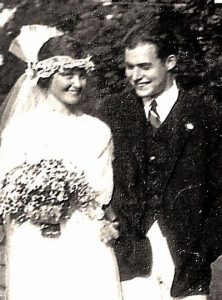
The end of marriage to Hadley
  • The Sun Also Rises was first published in 1926.
  • Hemingway died by suicide in 1961 at the age of 61.
  • The 100th anniversary of the novel’s publication will be celebrated in 2026.

THE PLAYERS

Ernest Hemingway

The renowned American novelist and short story writer, known for his pioneering minimalist style and exploration of the ‘lost generation’ of the 1920s.

Gertrude Stein

The influential American writer and art collector who famously described Hemingway’s generation as the ‘lost generation’ in a preface to The Sun Also Rises.

Clancy Sigal

The American novelist and screenwriter who wrote a spirited defense of Hemingway titled ‘Hemingway Lives’ in 2013.

Doris Lessing

The Nobel Prize-winning British novelist who connected the author to Clancy Sigal due to their shared political views and commitment to radical politics.

Martha Gellhorn

The American novelist, short story writer, and journalist who was married to Hemingway and traveled with him to Spain during the civil war and to China.

WHAT THEY’RE SAYING

“To be like Hemingway is to escape from a normal, dull life into one of adventure and risk, without complaining.”

— Clancy Sigal, Novelist and Screenwriter

“the only people for me are the mad ones, the ones who are mad to live, mad to talk, mad to be saved, desirous of everything at the same time.”

— Sal Paradise, Narrator of On The Road

WHAT’S NEXT

The 100th anniversary of the publication of The Sun Also Rises in 2026 will likely spur renewed academic and popular interest in Hemingway’s seminal work, with new critical analyses, adaptations, and celebrations of the novel’s enduring legacy.

THE TAKEAWAY

Hemingway’s The Sun Also Rises remains a touchstone of 20th century American literature, capturing the disillusionment and alienation of the ‘lost generation’ in the aftermath of World War I. As the novel marks its centennial, it continues to resonate with readers and writers, offering insights into the cultural shifts of the 1920s and Hemingway’s pioneering literary style.

Hemingway # 2 on list: The Old Man and the Sea–Short Books/Big Impressions

7 short books that make a big impression and cause a lasting impact

7 short books that make a big impression and cause a lasting impact
1/8

7 short books that make a big impression and cause a lasting impact

Some books don’t need hundreds of pages to leave a lasting mark. Short novels and novellas often capture powerful themes with sharp focus, emotional clarity, and memorable storytelling. Their brevity makes them accessible, yet their ideas stay with the reader long after finishing. Here are seven such short books that are widely celebrated for their depth, influence, and ability to provoke thought – all within a compact, impactful reading experience.

Animal Farm by George Orwell
2/8

Animal Farm by George Orwell

A deceptively simple fable about farm animals overthrowing their human owner – only to recreate an oppressive regime under their pigs. On the surface, it reads like a children’s story, yet it is a sharp allegory of power, corruption, and revolution. Its brevity and clarity make its message accessible but brutally effective; ideals can be corrupted by those who only seek power.

The Old Man and the Sea by Ernest Hemingway
3/8

The Old Man and the Sea by Ernest Hemingway

This short novel centers on an aging fisherman’s epic struggle to catch a giant marlin, exploring themes of perseverance, dignity, and the human spirit. Its spare, almost poetic language conveys deep emotional and existential weight. The old man’s battle with the sea becomes a metaphor for life’s challenges: painful, solitary – yet meaningful.

Of Mice and Men by John Steinbeck
4/8

Of Mice and Men by John Steinbeck

A tragic tale of two displaced ranch workers during the Great Depression, this novella explores dreams, friendship, loneliness, and cruelty. Its tight narrative and minimal cast make every moment count, intensifying emotional impact. The fragile hope and eventual heartbreak resonate long after reading, forcing reflection on human nature and social conditions.

The Metamorphosis by Franz Kafka
5/8

The Metamorphosis by Franz Kafka

In this bizarre, surreal novella, a man wakes up transformed into a giant insect. The story’s strangeness and brevity sharpen its themes of alienation, identity, and dehumanization. Kafka’s work unsettles and provokes: the weirdness forces readers to confront uncomfortable truths about isolation, family duty, and the fragility of human dignity.

The Stranger by Albert Camus
6/8

The Stranger by Albert Camus

A lean, philosophical novel about a man who commits a senseless crime and confronts the absurdity of existence. Its simple prose belies deep existential questions about meaning, morality, and society’s expectations. Short as it is, the novel challenges you to reflect – is life inherently meaningless, and if so, how should one live?

The Great Gatsby by F. Scott Fitzgerald
7/8

The Great Gatsby by F. Scott Fitzgerald

Though often considered a “short novel,” Gatsby paints a vivid portrait of ambition, love, wealth, and disillusionment in 1920s America. Its lyrical style, symbolic depth, and tragic arc create a powerful commentary on the American Dream. The glamour, longing, and inevitable collapse leave a haunting impression long after closing the book.

Siddhartha by Hermann Hesse
8/8

Siddhartha by Hermann Hesse

A spiritual novella about a man’s lifelong journey to self-discovery, inner peace, and meaning. It blends Eastern philosophy, introspection, and poetic simplicity – showing that profound transformation and wisdom can come from quiet reflection and life’s subtle experiences. Its brevity makes the journey intimate and personal rather than sprawling.

Short books prove that storytelling doesn’t need length to be powerful. The seven above-mentioned works remain to impact the readers due to their ability to combine the shortness with the depth, directness with the emotionality. Be it the excursion into society, human nature, philosophy, or an individual transformation, each book has an experience that remains long after reading. These are the short classics that you can read to start with in case you are seeking meaningful literature and you have a hectic schedule.

All Images Credit: Canva

Start a Conversation
Post comment
Follow Us On Social Media

Intriguing Project. Hope it gets out of development!

Ernest Hemingway feature in works with great-granddaughter Dree Hemingway aboard as executive producer

Actress and model Dree Hemingway (Starlet) is set to executive produce a new film about her legendary great grandfather, Ernest Hemingway.

The Hemingway Files will follow the writer’s last years, as his closest friends A.E. Hotchner and Duke MacMullen help him navigate his deepening mental struggles, his strained relationship with his trans daughter Gloria Hemingway, and the growing paranoia surrounding his belief that the FBI, under the direction of J. Edgar Hoover, was watching him.

The film is produced by Jeremy Bolt (Resident Evil) and will be directed by Jessica M. Thompson, whose projects include SXSW-winning debut The Light of the Moon, Screen Gems thriller The Invitation, which made $38 million global, and Showtime series The End.

The project is being produced under JB Pictures. Script comes from Cory Todd Hughes and Adrian Speckert (Armor). The film is currently in development with casting discussions underway.

Hemingway is the totemic U.S. author, Nobel Prize winner and larger-than-life personality known for novels including The Sun Also Rises, A Farewell to Arms, For Whom the Bell Tolls and The Old Man and the Sea.

Dree Hemingway, who has starred in films including Sean Baker’s Starlet and Noah Baumbach’s While We’re Young, said: “My great grandfather’s story has been told many times but rarely with this level of empathy and honesty. The Hemingway Files is about understanding him not as an icon, but as a father, a friend, and a man trying to hold on to himself.”

“This is one of the most important scripts of our lives,” Hughes and Speckert said in a joint statement. “Dree Hemingway’s support and trust in this project mean the world to us. We feel a deep responsibility to tell the truth of what Hemingway endured in those last years, his battles with his mind, his government, and his heart. The world deserves to know who he really was beneath the myth.”

Thompson said her vision is to approach Hemingway’s decline “with empathy and honesty. I want to peer underneath the mask of Hemingway’s legend and lay bare the truth of this multifaceted artist. I’m fascinated by the intersection of myth and reality. Hemingway’s story isn’t just about a writer grappling with obsolescence, it’s about the cost of masculinity, the fragility of family, and the truth that even the strongest among us can struggle.”

Several screen projects have explored Hemingway’s life including the 2012 HBO film Hemingway & Gellhorn, the 2015 movie Papa: Hemingway in Cuba and the 2021 Ken Burns documentary series Hemingway.

HMM. And yet they are still writing about Hemingway. So, I don’t see any reason to “reject” half of Hemingwayism. However, all may feel free to write as they wish, purple prose and all! What say you? (Photos added by me.)

New Hemingway Finding! Thank you, Curtis DeBerg! Read on!

New Discovery!

Hemingway writer and scholar, Curtis DeBerg, has brought forward an amazing note of Hemingway history that gives us insight, raises questions, and informs what we may think about Hemingway’s end.

In a New York Times Article published January 23, 2026, John Rosengren  covers the discovery of an inscription that Hemingway wrote by hand on June 16, 1961. He killed himself on July 2, 1961 with a gunshot. Hemingway who was at the Mayo Clinic receiving treatment for depression at the time he wrote an inscription in “The Old Man & The Sea” to one of the nuns who was caring for him named Sister Immaculata. For those of us who read and love Hemingway, it is profound. It reads as follows:

             “ To Sister Immaculata: this book, hoping to write another one as good for her when my writing luck is running well again, and it will.”

                Ernest Hemingway, St. Mary’s, June 16, 1961”

 Hemingway entered a psychiatric unit at St. Mary’s Hospital affiliated with the Mayo Clinic in November of 1960 and stayed until almost the end of January 1961. He received electroshock therapy and returned to the facility in April 1961 for additional care. The public was unaware of his condition and his wife Mary signed him in claiming it was for high blood pressure.

Hemingway was released by the chief psychiatrist claiming that he was well enough to go home. He lived in Idaho at that point.

Here is where Curtis DeBerg comes in. The book appears to have been largely forgotten until 5 years ago when one of the Sisters mentioned it to Curt who was doing research at the Mayo Clinic. At the time, Curt thought, “Was he kidding himself thinking he was going to be able to write again after all those electroshock treatments or is he thinking in the back of his mind “I’ll never write another book like this.””

Until now, the book with its inscription was locked up and largely forgotten on the shelves in the library at St. Mary’s Hospital. Five years ago, one of the Sisters mentioned it to Curtis DeBerg who has written two books about Hemingway and was doing research at the Mayo Clinic. DeBerg who wrote “Traveling the World with Hemingway” and the more recent “Wrestling with Demons” also about Hemingway, appropriately said more people should see this and it’s a part of very important Hemingway history.

DeBerg wonders if Hemingway was kidding himself thinking he was going to be able to write again after all those electric shock treatments or was he thinking in the back of his mind “I’ll never write another book like this.” He also ponders if the sunniness of the note was designed to convince the Mayo Clinic doctors that he was ready for release which he was not.

When DeBerg toured the Nobel Prize museum and learned it had no Hemingway artifacts he suggested the Franciscans donate at St. Mary’s the book. The order’s Leadership Counselor agreed to do so and turned it over to DeBerg in November. At the ceremony in Sweden on January 23, DeBerg discussed the inscription’s significance and it will now rest at the museum.

Endless gratitude to Curtis DeBerg for seeing the book and its inscription and making it known to the rest of the world. Even in his despair or hope depending on how you see this, Hemingway showed kindness and gratitude to Sister Immaculata which was the flipside of his aggressive side and what I like to think is his true, mid-western nature.

What a find! So much to think about and discuss.

With much gratitude to Curt who brought this to my attention. Thank you, Curt, for your dedication to Hemingway’s memory.

The Article Notes 10 winners but features only the first 5: Hemingway 1954


Ayukta Zisha
OCT 6, 2025, 06:30 EDT

The United States boasts a rich history of Nobel laureates whose achievements have profoundly influenced science, literature, and peace. These exceptional figures, including pioneering scientists, visionary writers, and inspiring leaders, represent America’s innovation and commitment to progress. Their remarkable accomplishments and lasting legacies have advanced human knowledge and inspired generations to strive for a better world.

Famous American Nobel Prize Winners

Famous American Nobel Prize Winners

The United States has a historical reputation for being home to some of the most eminent Nobel Prize winners internationally, whose paths of achievement have impacted the progress of the world in science, literature, peace, and more. These exceptional figures represent America’s innovation, leadership, and creativity. They include pathfinding scientists, visionary writers, and inspiring leaders whose commitment to peace and equality has informed the course of humanity.

Each Nobel laureate has improved the state of human knowledge and inspired each new generation to dream a little bigger and achieve more towards making the world a better place. The following list of the top 10 famous American Nobel prize winners highlights the remarkable accomplishments and lasting legacies of those shifted the course of history through their brilliance and purpose.

Top 10 Famous American Nobel Prize Winners

Here are the top 10 famous americans who have won nobel prize along with the year of their achievement and field in which they have specialised:

No.

Name

Year

Field

1

Martin Luther King Jr.

1964

Nobel Peace Prize

2

Barack Obama

2009

Nobel Peace Prize

3

Ernest Hemingway

1954

Nobel Prize in Literature

4

Richard P. Feynman

1965

Nobel Prize in Physics

5

John Bardeen

1956 & 1972

Nobel Prize in Physics

6

Bob Dylan

2016

Nobel Prize in Literature

7

Toni Morrison

1993

Nobel Prize in Literature

8

Albert A. Michelson

1907

Nobel Prize in Physics

9

Henry Kissinger

1973

Nobel Peace Prize

10

Frances H. Arnold

2018

Nobel Prize in Chemistry


Google Preferences

1. Martin Luther King Jr. – Nobel Peace Prize (1964)

Martin Luther King – civil rights leader, master of resiliency > Vance Air Force Base > Article Display

Dr. Martin Luther King Jr. received the Nobel recognition Nobel Peace Prize for his nonviolent fight against racial injustice and segregation in the United States.  Through his example as a gifted orator and a leader of the Civil Rights Movement, he personified the ideals of human rights, justice, and treatment commensurate with equality and peace around the globe.  King’s inspired words and nonviolent action made him a universal moral voice of the age and etched his legacy in the U.S. and world history.

2. Barack Obama- Nobel Peace Prize (2009)

Text of Barack Obama's Nobel Peace Prize acceptance speech - CSMonitor.com

Barack Obama was awarded the Nobel Peace Prize for his efforts to strengthen diplomatic relations and collaboration among countries. He was recognized for his vision of a future where nations would not possess nuclear weapons or be defined by borders.

Obama emphasized the need for dialogue rather than the pursuit of war and fought for the ideals of hope and change. He promoted peace, dialogue with inclusion, and finding avenues for cooperation and commonality to the forefront of the world stage.

3. Ernest Hemingway – Nobel Prize in Literature (1954)

On this day in 1954: Ernest Hemingway was awarded the Nobel Prize for Literature.

For his remarkable prose and simple style, Ernest Hemingway received the Nobel Prize in Literature, particularly spotlighted through The Old Man and the Sea. Hemingway’s stories displayed themes of courage, perseverance, and struggles of humanity.

His distinctive style changed the course of modern stories, and influenced both writers and readers throughout the generations, through his straight forward style of a powerful story that portrayed the truth of dealing with life and humanity.

4. Richard P. Feynman – Nobel Prize in Physics (1965)

Richard Feynman: The Man Who Only Used His Intellect to Enjoy Life | by Ali | Medium

Famous physicist Richard P. Feynman received the Nobel Prize in Physics for his transformative research quantum electrodynamics. His research changed the way particles behaved and interacted with electromagnetic behaviors in particles.

Along with his research, Feynman became famous for his entertaining and informative lectures, his quick wit, as well as the spirit of curiosity-driven science. Feynman became an inspiration for countless generations of students and scientists in college and universities to examine the universe with creativity and wonder leading to a lasting impact on physics.

5. John Bardeen – Nobel Prize in Physics (1956 & 1972)

University of Wisconsin alum created first working transistor 70 years ago

John Bardeen is the only person ever to be awarded the Nobel Prize in Physics, twice. The first was awarded for his invention of the transistor, which changed the electronics industry and eventually opened the door to modern computing. The second honored his theory of superconductivity. Bardeen’s inventions changed technology and industry and positioned him as one of the most important scientists in modern history.


So: What do you think? Are women smarter not to run or not wanting to miss out and becoming bolder?

Miguel Oses,Suman Naishadham

Sunday 13 July 2025 09:38 EDT

At Pamplona’s San Fermín festival, a tiny minority of women run with bulls

Show all 4

Spain Running of the Bulls Women
Spain Running of the Bulls WomenSpain Running of the Bulls WomenSpain Running of the Bulls

Dressed in the traditional bull runner’s garb of a white shirt and red neck-scarf, Yomara Martínez, 30, sprinted in the death-defying morning run or “encierros” taking place this week in the northern Spanish city of Pamplona.

Yet despite being in a crowd of thousands, Martínez was among only a handful of women daredevils running with the stampeding bulls at the San Fermín Festival.

“At the end of the day, the bull doesn’t know about sexes, age or body shape,” Martinez said. “It doesn’t matter if you are woman.”

Women bull runners are rare, though Martínez and other women taking part in the adrenaline-fueled tradition as more than mere spectators say it’s growing in popularity.

“There are times I feel small. And ask myself ‘what am I doing here?’ Because, although you may not want to, you do feel slightly inferior because of your physique,” said 32-year-old Sara Puñal, an administrator who took part in Sunday’s run.

“But in the moment, you are all equal,” Puñal said of the run.

The bulls pound along the twisting cobblestone streets after being led by six steers. Up to 4,000 runners take part in each bull run, which takes place over 846 meters (2,775 feet) and can last two to four minutes.

The expert Spanish runners try to sprint just in front of the bull’s horns for a few seconds while egging the animal on with a rolled newspaper. Gorings are not rare, but many more people are bruised and injured in falls and pileups with each other.

“I think many have a desire to see what it feels like but they don’t try because of fear,” said Paula López, 32, a shop assistant who also took part in a run earlier in the week. López said she grew up in the masculine world of bull fighting. She wasn’t fazed by how few women take part in the event.

“It’s complicated, but it is pretty exciting,” López said.

The event’s reputation took a hit years ago following complaints by women about having suffered sexual harassment and abuse from revelers.

In 2016, five men raped an 18-year-old woman during the festival in an infamous case that sparked an outcry across Spain. The men, who had a WhatsApp group named “La Manada,” or “The Animal Pack,” were imprisoned for 15 years by the Supreme Court in 2019.

Since then, organizers have said they’ve stepped up security measures.

Women didn’t participate in the bull runs until 1975 due to a decree repealed one year earlier that prohibited women, children and the elderly from being in the streets where the bulls run during the festival.

The spectacle was made internationally famous by Ernest Hemingway’s classic 1926 novel “The Sun Also Rises,” about American bohemians wasting away in Europe.

——

Naishadham reported from Madrid.

Last minute Christmas Present? A mere $ 83,000. Happy Holidays all! Christine

AUCTIONS | DECEMBER 15, 2025
Hemingway Presentation Copy of The Old Man and the Sea Inscribed to Spencer Tracy Sold for $83K
BONHAMS

Ernest Hemingway’s The Old Man and the Sea with inscription to Spencer Tracy

Leading Bonhams’ ‘white glove’ Spencer Tracy: Collection of a Screen Icon auction was an advance issue presentation copy of The Old Man and the Sea by Ernest Hemingwaywhich soared to more than 55 times its estimate when it sold for $83,050.

One of only 30 pre-publication copies printed in August 1952, this example is one of just two known copies inscribed by Hemingway bearing a personal inscription to Spencer Tracy who would later portray Santiago in the 1958 film adaptation.

Other major standouts from the sale included:

  • a first edition, presentation copy of John F. Kennedy’s first book, Why England Slept(1940), inscribed to Spencer Tracy, which sold for $15,360, more than seven times its estimate
  • a painting by actress Katherine Hepburn ($9,600)
  • Peter Pan and Tinkerbell reproduction celluloid print from the Disney Peter Pan movie, signed by Walt Disney Disney, 1953 ($9,600)

READ MORE